Microplastics are inside you right now. Here's what that actually means.
They've been found in human blood, brains, testicles, placentas, breast milk, and lungs. The question is no longer whether you have them — it's what they're doing in there.
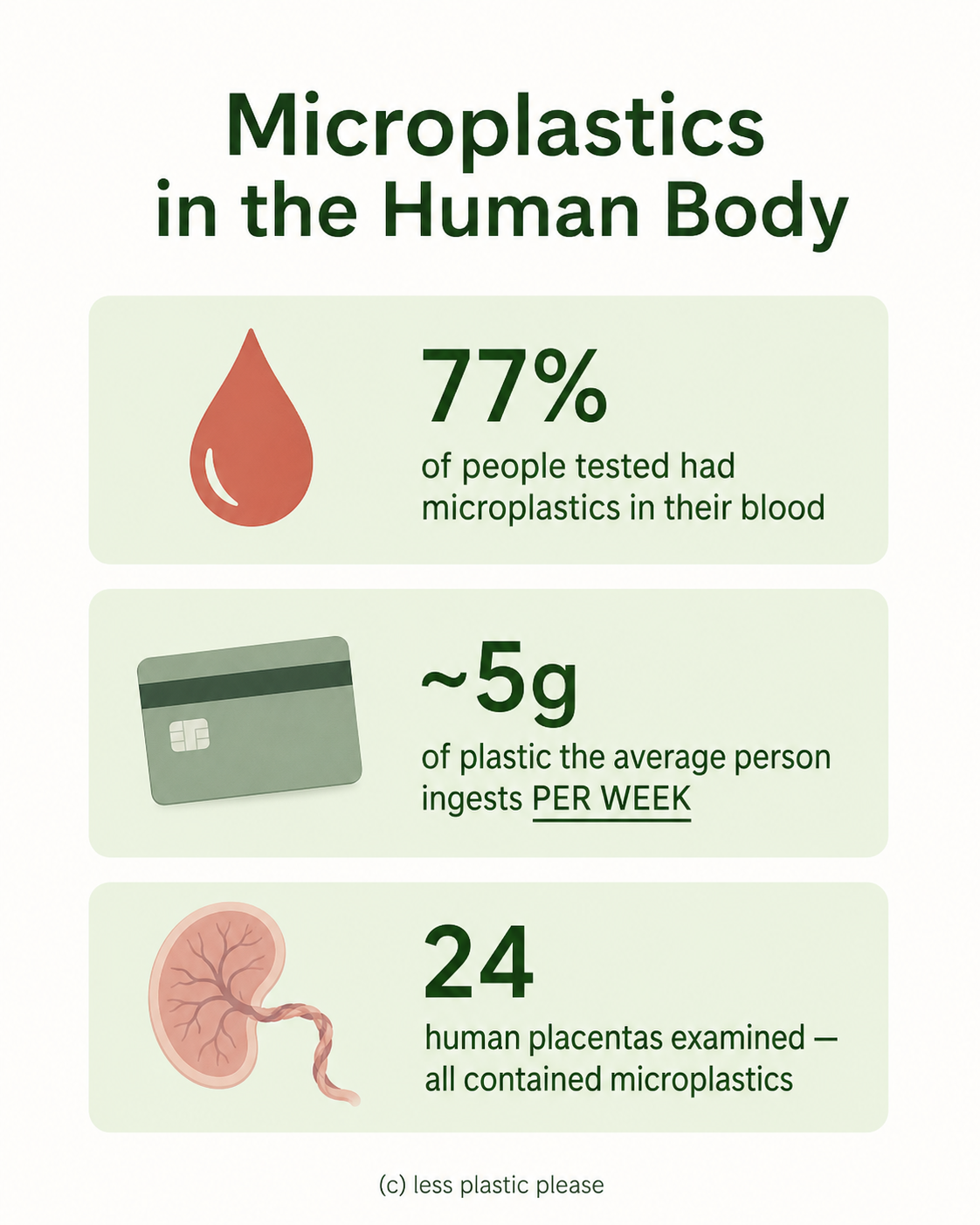
Researchers have found microplastics in the blood of 77% of people tested. They've been found in every human placenta examined in a 2020 Italian study. They've been found in human breast milk, in the testicles of both humans and dogs, and — in a 2024 study out of the University of New Mexico — in human brain tissue at concentrations higher than anywhere else in the body.
You have plastic in your brain. So do we. So does basically everyone reading this (there’s dozens of us!).
The question isn't "are you sure about that?" anymore. It's: "okay, so how does that affect me?" That's the harder question, and we're going to answer it honestly — including the parts where the science is still catching up.
ATLA Presents: plastic-bending
Imagine intentionally eating a credit card every week.
What we're actually talking about
Plastic doesn't disappear. When a plastic bottle breaks down — from UV light, wave action, or time — it doesn't biodegrade. It just gets smaller. Pieces under 5 millimeters are microplastics. Pieces under 1 micrometer are nanoplastics. Both enter the body. Nanoplastics, being smaller than most cells, are thought to be more dangerous because they can cross biological barriers that were never designed to deal with them — including the blood-brain barrier.
The sources are everywhere, and we mean that literally. Microplastics have been found in clouds over Mount Fuji, in deep-sea sediments in the Mariana Trench, in Antarctic ice cores, and in the lungs of bottlenose dolphins. We are not dealing with a localized pollution problem. We are dealing with a global contamination event that is, at this point, irreversible at the environmental scale.
“We found that the brain had significantly higher concentrations of microplastics than the liver or kidneys. The particles were accumulating there.”
What it might be doing to your body
Here's where we have to be honest: the science is robust on presence, still developing on causation. We know the particles are there. We know less about exactly what they're causing, because studying long-term low-dose exposure in humans takes decades, and plastics have only been ubiquitous since the 1960s. That said, what we do know is not reassuring.
Microplastics are not inert. Many carry chemical additives — plasticizers like phthalates and BPA, flame retardants, UV stabilizers — that are known endocrine disruptors. These chemicals interfere with hormones, and the research on them is considerably more developed than the research on the physical particles themselves.
In cell and animal studies, microplastic exposure is associated with: oxidative stress and inflammation, disruption of reproductive hormones, impaired sperm motility (the testicle study found that men with higher testicular microplastic concentrations had lower sperm counts), potential disruption of the gut microbiome, and neurological effects in animal models.
A 2024 study in the New England Journal of Medicine found that patients with microplastics in their arterial plaque were 4.5 times more likely to have a heart attack, stroke, or die over a 34-month follow-up period compared to those without. This is the most alarming human health data published to date, and it received about a tenth of the coverage it deserved.
What we don't know yet
We deserve to know the limits of current science, not just the scary parts that make headlines. Researchers are still working to establish: what dose causes harm in humans (most studies are animal or cell-based), whether the body can clear microplastics over time, whether all plastic types are equally harmful, and whether the chemicals attached to particles or the particles themselves are the primary driver of harm.
What we can say clearly: the trajectory of research is not moving in a reassuring direction. Every new study that comes out finds plastic somewhere new, or finds an association with something bad. No study has come out and said "actually, we found microplastics in human brains and it’s all good!".
So what do you do with this information?
Well, you don't panic. Panic is useful for exactly zero things. What you do is reduce your exposure where you reasonably can — starting with the highest-exposure sources — while supporting policy change that addresses this at the systemic level where it actually matters.
Individual action without systemic change is like bailing out a boat with only one hand. But many hands matter, especially when they come with a vote, a dollar, and a voice.
We'll cover the specific swaps — the ones with the highest impact — in the next two articles. Start there. Then come back here when you need to remind yourself why it's worth the effort.
Don't miss what comes next
We publish one science piece and one practical swap guide every week. No fluff, no sponsored content (though we may have the occasional heavily vetted affiliate link that helps keep us alive), no pretending this problem is smaller than it is. Sign up for The Plastic Dispatch — our weekly newsletter — and we'll send it straight to you.
